



ALK1
ALK1 (activin receptor-like kinase 1), encoded by ACVRL1, is an endothelial-enriched transmembrane serine/threonine kinase receptor within the transforming growth factor-β (TGF-β) receptor superfamily that plays a central role in vascular development, endothelial homeostasis, and angiogenic regulation[1][2][3]. Mechanistically, ALK1 functions as a type I receptor that responds primarily to the circulating ligands BMP9 and BMP10, activating downstream SMAD1/5/8-dependent transcriptional programs that regulate endothelial behavior and vascular quiescence[4][5][6]. Continuous BMP10-mediated ALK1 signaling is required for vascular maintenance, and disruption of this pathway leads to arteriovenous malformations, highlighting its importance in endothelial integrity[4]. Consistent with this function, loss-of-function mutations in ACVRL1 are a major cause of hereditary hemorrhagic telangiectasia type 2 (HHT2), a vascular disorder characterized by abnormal artery-vein connections and pathological angiogenesis[1][4][7]. ALK1 mutations have also been associated with pulmonary arterial hypertension and altered endothelial transcriptional responses to BMP9 and BMP10 stimulation. Compared with related TGF-β family type I receptors, ALK1 exhibits marked endothelial-cell specificity, particularly in arterial endothelial cells, distinguishing its biological role from more broadly expressed receptor kinases[1][2]. For experimental applications, recombinant BMP9 and BMP10 are widely used to activate ALK1 signaling, whereas ALK1-targeting antagonists and ligand-trap strategies have been investigated to modulate angiogenesis and vascular remodeling in preclinical disease models, including cancer-associated angiogenesis[6][8][9].
Verweise:
- [1]. Roman BL, et al. ALK1 signaling in development and disease: new paradigms. Cell Mol Life Sci. 2017 Dec;74(24):4539-4560. [Content Brief]
- [2]. ALK1 gene information from NCBI.
- [3]. Cunha SI, et al. ALK1 as an emerging target for antiangiogenic therapy of cancer. Blood. 2011 Jun 30;117(26):6999-7006. [Content Brief]
- [4]. Capasso TL, et al. BMP10-mediated ALK1 signaling is continuously required for vascular development and maintenance. Angiogenesis. 2020 May;23(2):203-220. [Content Brief]
- [5]. Tillet E, et al. Emerging roles of BMP9 and BMP10 in hereditary hemorrhagic telangiectasia. Front Genet. 2015 Jan 8;5:456. [Content Brief]
- [6]. Sciencedirect.topics.
- [7]. National Library of Medicine.
- [8]. Claesson-Welsh L. Alk1 (Activin Receptor-Like Kinase 1) and Vascular Hyperpermeability in Diabetic Retinopathy. Arterioscler Thromb Vasc Biol. 2018 Aug;38(8):1673-1675. [Content Brief]
- [9]. Ayuso-Íñigo B,et al. The Dual Effect of the BMP9-ALK1 Pathway in Blood Vessels: An Opportunity for Cancer Therapy Improvement? Cancers (Basel). 2021 Oct 28;13(21):5412. [Content Brief]
All Product Categories
-
ALK1 Verwandte Produkte (9)
Verwandte Produkte (9)

-
Recombinant Proteins (9)
-
LDN-214117
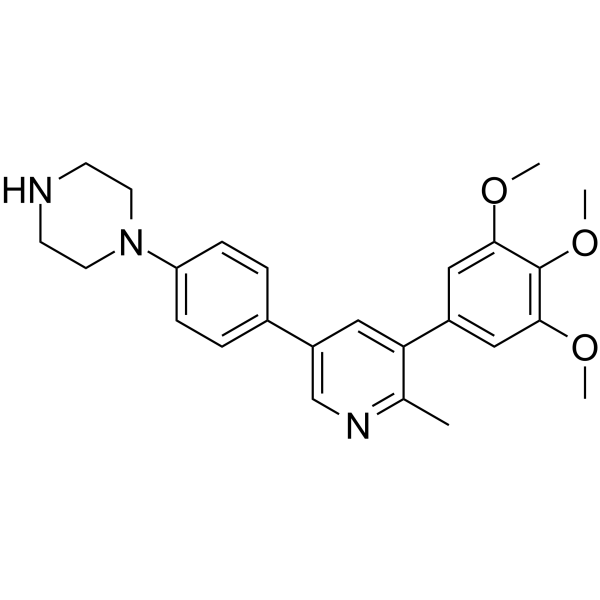 0 ImagesLDN-214117 is an orally active ALK2 inhibitor with well-tolerated and good brain penetration. LDN-214117 has a high selectivity and low cytotoxicity for ALK2 with an IC50 value of 24 nM. LDN-214117 also is a specific bone morphogenetic proteins (BMPs) signaling inhibitor and has relatively selective inhibition for BMP6 with an IC50 value of 100 nM. LDN-214117 can be used for the research of fibrodysplasia ossificans progressiva (FOP), diffuse intrinsic pontine glioma (DIPG) .
-
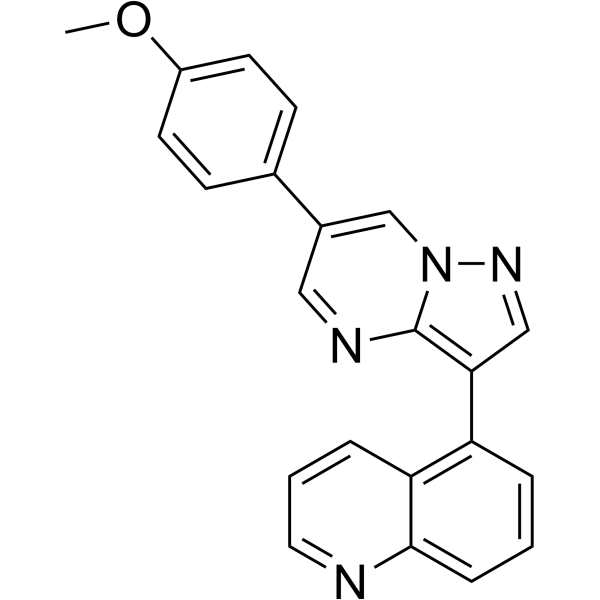
LDN-212854
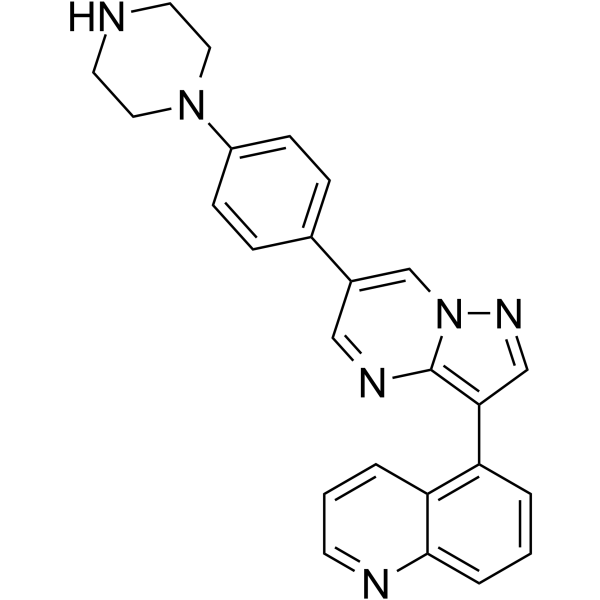 0 ImagesLDN-212854 is a bone morphogenetic protein (BMP) inhibitor that potently inhibits ALK2 (IC50: 1.3 nM). LDN-212854 also inhibits ALK1 (IC50: 2.40 nM). LDN-212854 can be used in the research of fibrodysplasia ossificans progressive and cancers, such as hepatocellular carcinoma (HCC).
-
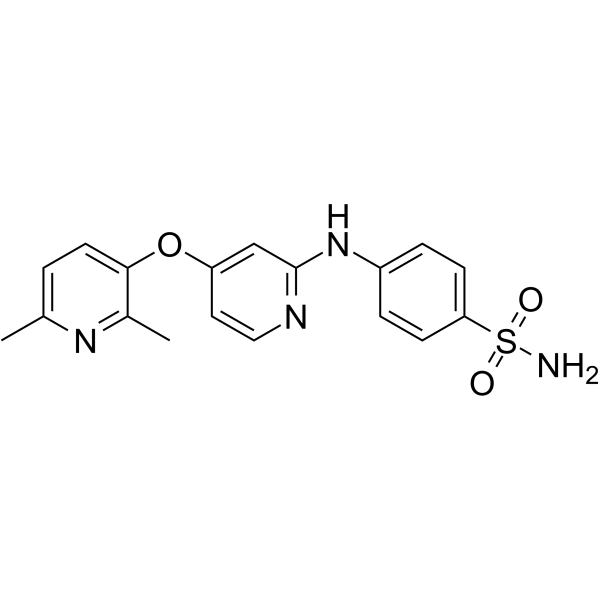
Fidrisertib
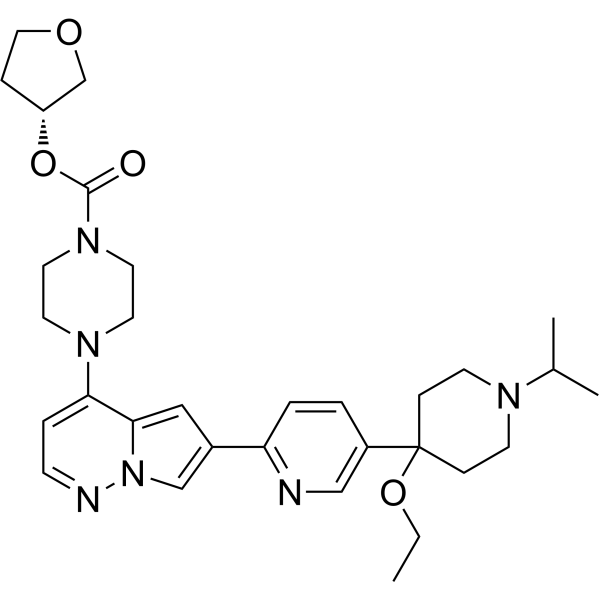 0 ImagesSynonyms: BLU-782; IPN-60130; ALK2-IN-1
-
HM-279
 0 ImagesArt. -Nr.: HY-185430CAS. Nr.: 3039954-64-5HM-279 is a potent and orally active ALK5 inhibitor with an IC50 of 4.7 nM. HM-279 shows cross-reactivity with ALK7 (IC50 = 6.8 nM), but HM-279 has fair to good selectivity against other TGF-β receptor family kinases, with 4.5-693-fold selectivity. HM-279 demonstrates antitumor activity in vivo through CD8+ T cell immunity. HM-279 can be used for the research of colon cancer.
-
CDD-2789
 0 ImagesArt. -Nr.: HY-173149CAS. Nr.: 3052084-77-9
-
CDD-1115
 0 ImagesArt. -Nr.: HY-171248CAS. Nr.: 3034215-86-3CDD-1115 is a BMPR2 serine/threonine kinase inhibitor with an IC50 of 1.8 nM against human BMPR2 kinase. CDD-1115 selectively inhibits the catalytic activity of BMPR2, and shows weak inhibitory effects on ALK1 and ALK2.
-
MU1700
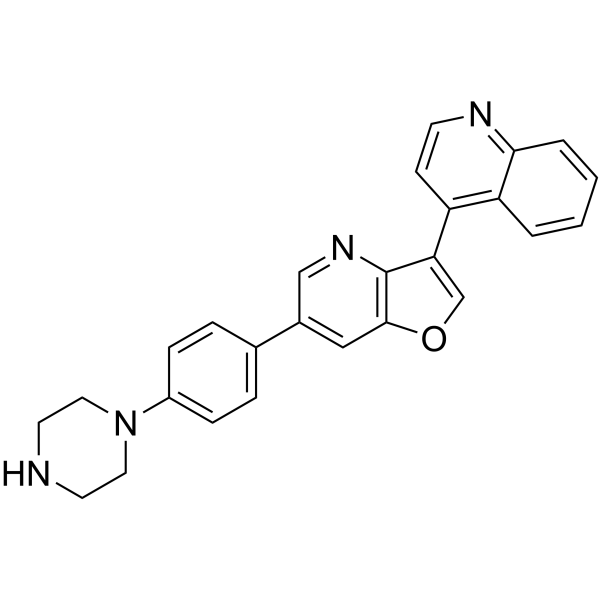 0 ImagesArt. -Nr.: HY-148246CAS. Nr.: 3055312-41-6MU1700, a chemical probe, is an orally active and potent ALK1/2 inhibitor with IC50s of 13 nM and 6 nM, respectively. MU1700 shows cell membrane permeability and high brain permeability.




